
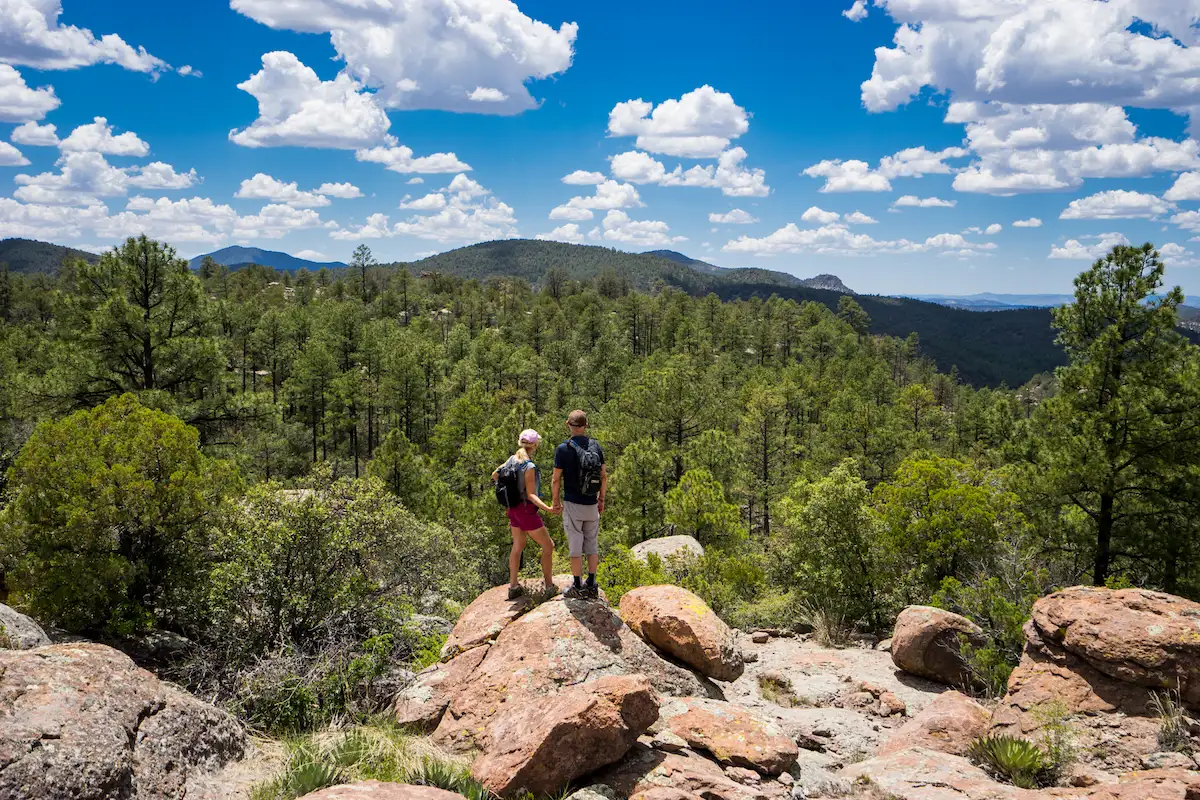
The Gila National Forest sprawls across southwestern New Mexico, offering more designated wilderness than any other national forest in the Southwest. Its forested peaks, high desert canyons, and dramatic geology give visitors a genuine sense of solitude that’s increasingly rare to find. Silver City sits right at the forest’s doorstep, making it the natural jumping-off point for exploring everything Gila has to offer. Whether you’re soaking in a centuries-old hot spring or tackling a stretch of one of the country’s longest trails, the region rewards hikers of every skill level.
Key Takeaways:
- The Gila is home to two popular hot springs, both reachable by trail from the Gila Visitor Center.
- Silver City is an official Gateway Community for the Continental Divide National Scenic Trail (CDT), with two fee-free access points nearby.
- Jack’s Peak and Burro Peak offer summit views accessible from CDT spur routes near Silver City.
- Trails like the Catwalk, Dragonfly Loop, and Signal Peak provide options for every fitness level and time budget.
- Elevation changes can swing temperatures dramatically, so proper preparation and packing the right essentials matters.
A Landscape Shaped by Fire and Water
The Silver City Ranger District is the southernmost district in the Gila National Forest, combining the Burro Mountain region, the area around Silver City, and part of the Black Range into more than 400,000 acres of terrain. The climate here is famously mild, with four gentle seasons and an average annual temperature around 54 degrees. May tends to be the driest month, while July and August bring the most rain, so hikers planning trips around water sources or river crossings should keep seasonal timing in mind.
Soaking in the Gila’s Hot Springs
Two hot springs stand out as the most visited in the region: Lightfeather Hot Spring and Jordan Hot Spring. Both are mineral-rich and have drawn visitors for generations, including the Mogollon people long before the area became a national forest. They’re sometimes called “sweet springs” because they lack the salt and sulfur content that gives many hot springs their pungent odor.
Lightfeather Hot Spring sits about ¾ mile from the Visitor Center at the Gila Cliff Dwellings National Monument, along Trail 157, the Middle Fork Trail, and takes most hikers roughly 20 minutes to reach. Because the water here runs scalding hot, visitors and locals have built rock-lined pools along the Middle Fork to make soaking safer, though it’s still worth watching for hot rocks near the water’s edge.
Jordan Hot Spring is a bigger commitment. Located about 7 miles from the Visitor Center via Trail 729, or Little Bear Canyon, the hike is strenuous enough that most people turn it into an overnight trip rather than a single-day push. The payoff is a spring about 20 feet wide and 3 feet deep, with a comfortable, consistent temperature near 94 degrees, earning it the label of a “warm spring” rather than a scalding one.
Walking a Piece of the Continental Divide Trail
For hikers looking for something longer, the Continental Divide National Scenic Trail cuts 248 miles through the Gila. The full CDT runs an astonishing 3,100 miles across five states.
Silver City has earned its status as an official CDT Gateway Community, meaning the town is dedicated to supporting and protecting the trail for the hikers who pass through. Two access points near town make it easy to sample the CDT without committing to a thru-hike, and neither charges a fee.
Heading north out of Silver City, hikers can reach the trail via Little Walnut Road, continuing past the Gomez Peak Day Use Area and Little Walnut Picnic Area on FR 506. About 1.8 miles after the pavement turns to dirt, a parking area on the left marks the trailhead. From there, hikers can head south for sweeping views of Bear Mountain and a descent into the Walnut Creek drainage, or north toward views of the Our Lady of Guadalupe Benedictine Monastery, which borders the forest.
Heading south from Silver City on NM 90 for about 20 miles leads to a Forest Service-marked trailhead offering a different CDT experience, climbing to Jack’s Peak at 7,986 feet and Burro Peak at 8,035 feet. The views along the way and from each summit are considered some of the best in the area. Past Burro Peak, the trail descends toward Tyrone Road, connecting back to NM-90 about 11 miles south of town.
Hikers interested in exploring lesser-known access points can check with a local outdoor shop for guidance, since not all trailheads are well marked. Thru-hikers and trail enthusiasts might also plan a visit around CDT Trail Days, a community celebration for hikers and stewards next scheduled for April 22–25, 2027.
Shorter Trails Worth the Trip
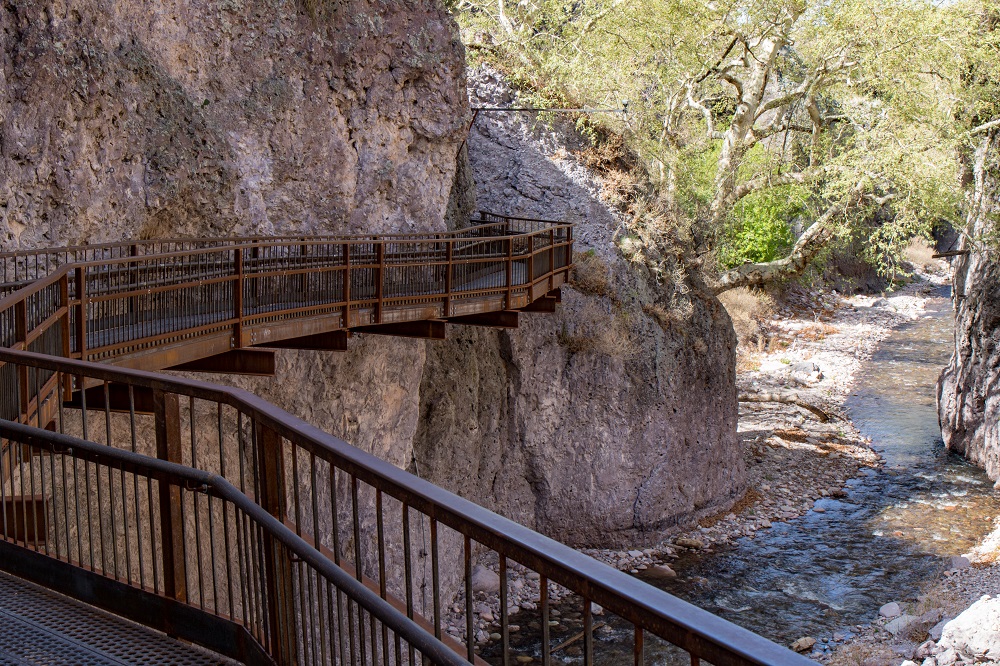
Not every hike in the Gila National Forest requires an overnight pack. The Catwalk National Recreation Trail, Trail #207, is an easy 0.75-mile walk along a metal catwalk suspended above hidden pools and waterfalls; a $5 day-pass fee applies for parking. From there, the more demanding Whitewater Trail #207.1 continues another 16.8 miles up the Whitewater Creek drainage for hikers wanting more distance.
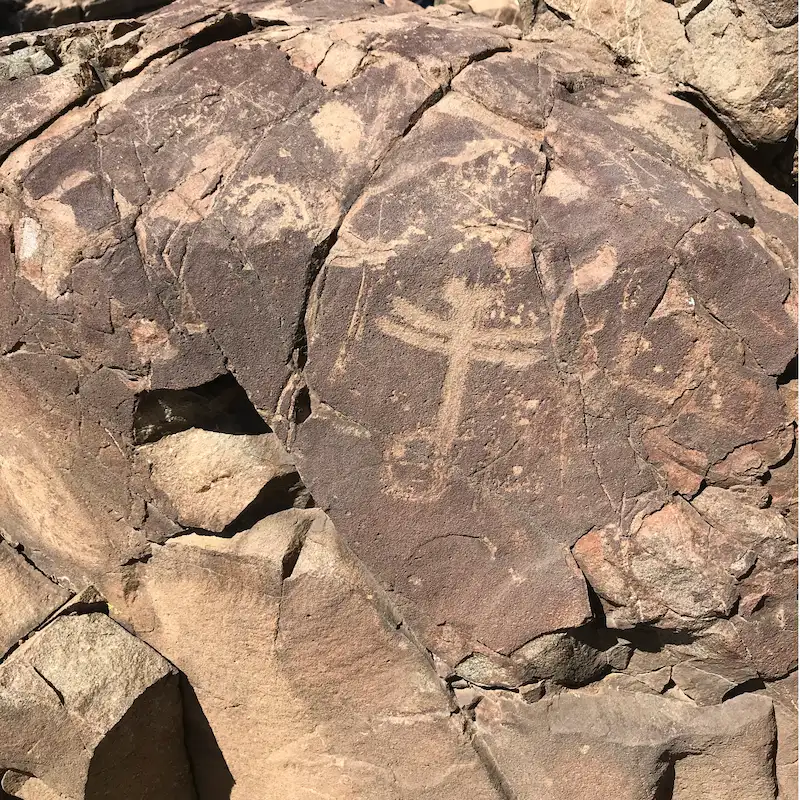
The Dragonfly Loop Trail, #720, which is not far from Silver City, offers a fee-free, two-mile loop through pinon-juniper woodlands and high desert scenery, highlighted by ancient dragonfly petroglyphs along the way. It’s considered suitable for hikers of nearly any age or ability.
For something more strenuous, the Signal Peak Trail, #742, climbs 5 miles out and back to Signal Point at 8,000 feet, rewarding hikers with panoramic views and a look at the Signal Peak Fire Lookout Tower, also with no fee required.
Hiking Smart in the Gila
Given the size and remoteness of the Gila National Forest and the Gila Wilderness, basic precautions go a long way. Stick to marked trails, hike with a companion when possible, and always tell someone who isn’t joining you what your plan is. Carry plenty of water, pace yourself, and dress appropriately, sturdy hiking boots make a real difference on the Gila’s rocky terrain. Even short day hikes call for the essentials: a map, sunglasses, sunscreen, a flashlight, waterproof matches, a first aid kit, water-purifying tablets, high-energy snacks, and extra clothing. Temperature swings can be dramatic here, dropping three to five degrees for every 1,000 feet of elevation gained, so what starts as a warm morning at the trailhead can turn cold fast near a summit.
